What “As-Is” Really Means in a Real Estate Transaction
Selling a property as-is sounds simple. The seller does not make repairs, the buyer takes the property in its current condition, and everyone moves toward closing. In practice, there is more nuance to it than that.
An as-is sale generally means the seller is not agreeing to repair, update, or improve the property before closing. The buyer evaluates the home as it sits today and decides whether the condition, price, timing, and overall structure make sense. That can remove a significant amount of work from the seller, especially when a property needs repairs or has been difficult to maintain.
What it does not mean is that the condition of the property suddenly stops mattering. It does not eliminate due diligence, title work, inspections, disclosure obligations, or the buyer’s need to understand what they are purchasing. The phrase “as-is” describes who is expected to take responsibility for the property’s existing condition. It does not make the rest of the transaction disappear.
The Property Still Has to Be Understood
The clearest way to think about an as-is sale is that the buyer is agreeing to evaluate the property in its present condition rather than expecting the seller to renovate it before closing. That distinction matters because there is a real difference between accepting a property in its current condition and agreeing to ignore everything about that condition.
A buyer may still want to understand the roof, foundation, plumbing, electrical systems, HVAC, windows, drainage, occupancy, title, and any other issue that could affect the property. If the home has an older roof, active water intrusion, outdated wiring, or structural concerns, those things still have a financial impact even though the seller is not being asked to fix them.
The cost does not disappear simply because the property is being sold as-is. Someone still takes on that responsibility. In an investor transaction, those costs and risks are usually reflected in the evaluation and ultimately in the offer. That is why two as-is properties can receive very different offers even when they are similar in size or location.
Sellers Are Often Trading Repairs for Simplicity
For many sellers, the real value of an as-is sale is not simply avoiding a repair bill. It is avoiding the entire process that often comes with getting a property ready for the retail market.
That process can include finding contractors, deciding which repairs are worth making, managing the work, cleaning, painting, replacing flooring, removing belongings, improving curb appeal, coordinating showings, and hoping the money spent upfront produces a higher sale price later. Some sellers are perfectly comfortable doing that. Others are not.
An inherited property may be located several states away. A landlord may be tired of managing repairs between tenants. A homeowner may know the property needs work but not have the cash or time to address it. A family dealing with probate may simply have more important things to manage than renovating a house.
In those situations, an as-is sale can transfer much of that work and uncertainty to the buyer. That convenience has value, but it also has a tradeoff. If the buyer is taking responsibility for repairs, holding time, financing, contractor risk, and future resale uncertainty, those factors will usually affect what the buyer can reasonably pay.
The Price Usually Reflects the Work the Seller Is Choosing Not to Do
One of the easiest mistakes to make is comparing an as-is investor offer directly to the price of a renovated home nearby without accounting for what separates the two properties.
If a nearby home sold after receiving a new roof, updated kitchen, renovated bathrooms, fresh flooring, paint, landscaping, and other improvements, that sale may help show what buyers are willing to pay for a finished property. It does not mean an untouched property next door is worth the same amount today.
There is still a gap between the current property and that finished result. That gap may include repair costs, financing, taxes, insurance, utilities, contractor coordination, holding time, resale expenses, and the possibility that the final market value is different from what everyone expected at the beginning.
An as-is buyer is evaluating that gap. The seller is essentially saying, “I do not want to take this property through that process before selling it.” The buyer then has to determine whether they are willing to take on the work and what price allows the transaction to make sense.
As-Is Still Allows the Buyer to Do Due Diligence
Selling as-is does not usually mean the buyer agrees to purchase the property without learning anything else about it.
The buyer may still conduct a walkthrough, bring in contractors, review comparable sales, investigate title, confirm occupancy, review leases, or look more closely at repairs and property records. The exact rights and obligations depend on the purchase agreement and applicable law.
This is where some of the confusion around as-is transactions comes from. A seller may hear “we buy as-is” and assume that means the buyer will never inspect the property or reconsider anything. A buyer may use the same phrase to mean only that they are not asking the seller to complete repairs before closing.
Those are very different interpretations, which is why the contract should make the actual agreement clear.
A buyer can inspect an as-is property while still accepting responsibility for the repairs. The important question is what happens if the inspection or due diligence reveals something materially different from what was understood when the offer was made.
As-Is Does Not Mean Problems Should Be Hidden
Selling a property as-is is not the same thing as concealing known issues.
Disclosure requirements vary by state, property type, and transaction, so sellers should understand what applies to their specific situation. From a practical standpoint, though, we would rather know about a significant issue early than discover it late in the process.
If there has been a roof leak, foundation repair, fire, flood, plumbing failure, tenant issue, or other material problem, that information helps us evaluate the property more accurately. A known problem does not automatically make a property unattractive. Unexpected information can be much more disruptive.
If we understand the issue before making an offer, we can account for it. If the same issue is discovered after the property is under contract, everyone may have to revisit assumptions that were built into the original deal. Transparency usually makes as-is transactions easier, not harder.
Not Every As-Is Property Fits Every Buyer
A buyer saying they purchase properties as-is does not mean they purchase every property in every condition.
Different investors have different strategies, risk tolerances, experience, and capital available. One buyer may be comfortable with cosmetic renovations but avoid major structural work. Another may specialize in heavy rehabs. A landlord may be comfortable with a dated but rentable property while having no interest in a house that requires a full renovation before it can be occupied.
Location matters too. A property that needs substantial work may still be attractive in a market where renovated homes sell quickly and buyer demand is strong. The exact same repair scope may be much harder to justify in an area where resale demand is weak.
That is why the as-is designation does not determine the offer by itself. We still need to evaluate whether the property fits what we are buying, whether there is a realistic path forward, and whether the numbers make sense.
As-Is Can Be Especially Useful When Work Has Been Deferred
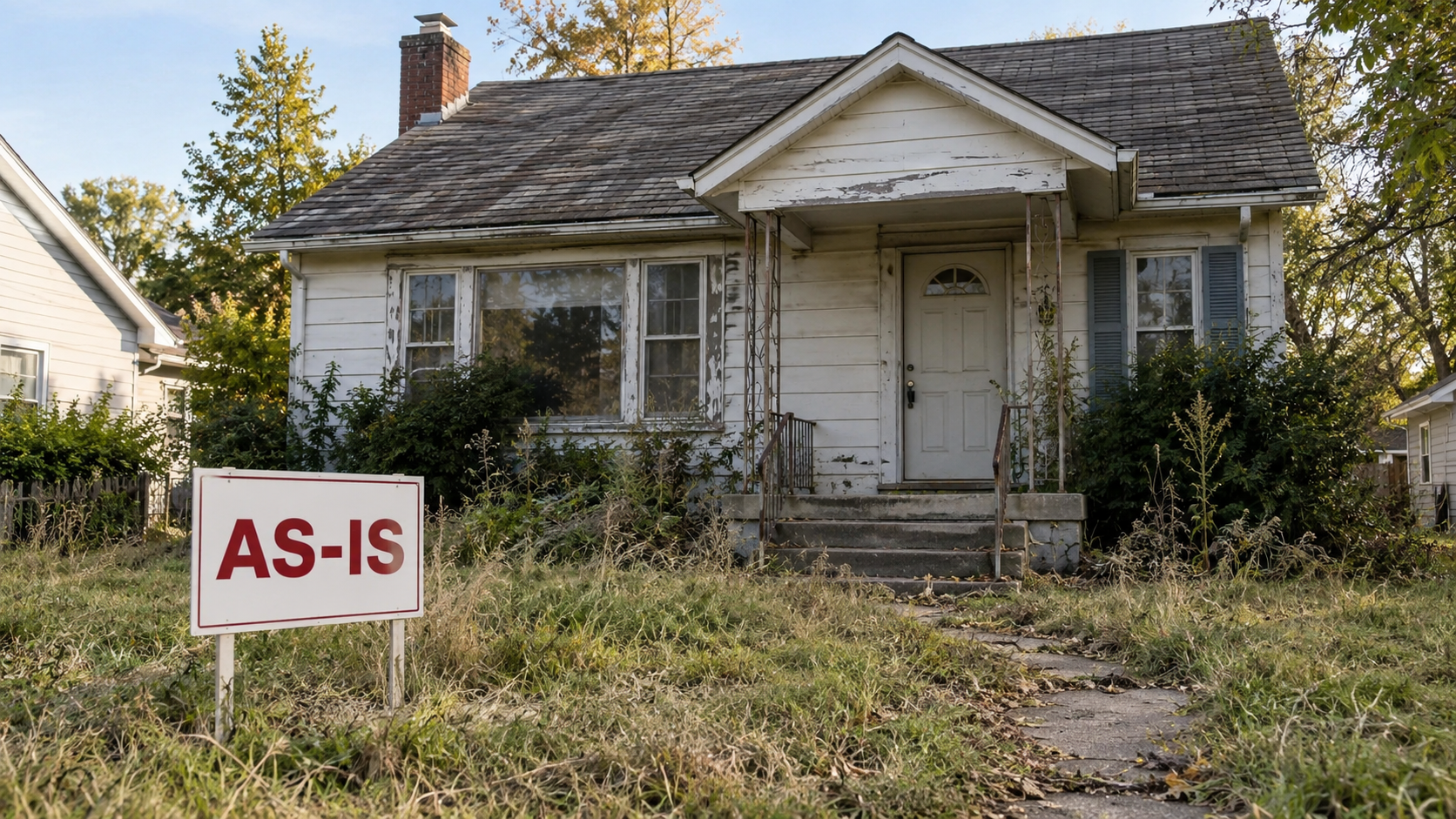
Some of the properties best suited to an as-is sale are not dramatically distressed properties. They may simply be homes where maintenance and updating have accumulated over time.
An older roof may still function but be nearing replacement. The kitchen may be twenty or thirty years old. The flooring may be worn. Landscaping may have been neglected. Several smaller maintenance issues may have accumulated because the owner did not want to keep putting money into the property.
Individually, none of those things may seem overwhelming. Together, they can create a significant amount of work before the property is ready for a traditional retail buyer.
For a seller who does not want to coordinate that process, an as-is sale can provide another path. Instead of preparing the property first and selling second, the seller transfers the property in its current condition and lets the next owner decide what improvements make sense.
As-Is Does Not Automatically Mean a Fast Closing
Another common assumption is that selling as-is automatically means the property can close immediately.
Sometimes it can. If the property is vacant, the title is clean, access is easy, and both sides are ready, the transaction may move relatively quickly.
But the physical condition of the property is only one part of the closing process. There may still be liens, probate, title issues, multiple owners, tenant arrangements, unreleased mortgages, judgments, documentation problems, or other circumstances that have to be resolved before ownership can transfer.
Those issues have nothing to do with whether the seller is making repairs. That is why we treat speed and condition as separate questions. An as-is sale can eliminate repair-related delays, but it cannot eliminate every other issue that may affect closing.
Comparing an As-Is Offer With a Traditional Sale
The best way to compare an as-is offer with a traditional sale is to look beyond the purchase price and ask what each option actually requires.
A traditional sale may produce a higher gross price, particularly if the property is in good condition or the seller is willing to prepare it for the retail market. But that path may also involve repairs, cleaning, staging, commissions, concessions, inspections, appraisal requirements, financing contingencies, and a longer timeline.
An as-is investor offer may come in lower, but the seller may avoid some of those costs, responsibilities, and uncertainties. The meaningful comparison is not simply between two numbers. It is between two complete transactions.
What will the seller actually net after expenses? How much work will they need to complete before closing? How certain is the transaction? How long may it take? What happens if the buyer’s financing or appraisal does not work? What repairs might still be negotiated after inspection?
Those questions often reveal more than the headline price alone.
When an As-Is Sale May Not Be the Best Choice
There are situations where an investor as-is sale may not be the strongest option for the seller.
If the property is already in good condition, the seller has time, and the retail market is strong, a traditional listing may produce a better financial result. There are also situations where a modest amount of work can create a disproportionate increase in value.
A property may not need a full renovation. It may simply need cleaning, paint, landscaping, or a few targeted repairs to appeal to a much larger pool of buyers.
In that situation, it may make sense for the seller to do some work before selling. That is why we do not believe “sell as-is” should automatically be treated as the answer for every property.
It is one option, and the right option depends on the property, the amount of work involved, the seller’s time and resources, local market conditions, and what the seller is actually trying to accomplish.
What We Look at When We Evaluate an As-Is Property
When REWholesalers evaluates an as-is property, we are trying to understand what exists today and what it may take to move the property to its next stage.
That includes the current condition, likely repairs, market value, buyer demand, occupancy, title, timing, and likely exit strategy. We are also thinking about how much uncertainty exists around those factors.
A dated but functional property with clear title may be relatively straightforward. A similar home with hidden water damage, tenant complications, and unresolved ownership questions may require a very different evaluation.
The point is not to penalize a property for being sold as-is. The point is to understand what the buyer is actually agreeing to take on. That is also why two sellers can both say, “I am selling as-is,” and still receive very different evaluations.
A Good As-Is Transaction Should Still Be Clear
The fact that the seller is not making repairs should not make the rest of the transaction vague.
The seller should still understand who the buyer is, whether the agreement may be assigned, how long the due diligence period lasts, what earnest money is being deposited, how closing costs are being handled, what access the buyer needs, and what conditions allow either party to terminate.
“As-is” should not become a substitute for explaining those things.
The condition of the property is only one piece of the agreement. A seller should understand both the property-related tradeoffs and the contractual structure of the transaction before deciding whether the offer fits.
We believe clarity matters because most problems in a transaction are easier to deal with when everyone understands the expectations early. That is true whether the house is in excellent condition or needs substantial work.
The Tradeoff Should Make Sense
At its core, an as-is sale is a tradeoff between what the seller is choosing not to do and what the buyer is agreeing to take on.
The seller may be giving up some potential price in exchange for avoiding repairs, reducing preparation, eliminating some uncertainty, or transferring more responsibility for the property’s current condition to the buyer. The buyer may be accepting that work, cost, and risk in exchange for the opportunity to improve, hold, resell, or otherwise create value from the property later.
When both sides understand that exchange, an as-is transaction can make a great deal of sense. The seller knows what they are choosing not to do before closing, and the buyer knows what they are accepting after closing. The price and terms then reflect those responsibilities.
That is very different from simply saying, “We buy houses as-is,” and leaving the seller to guess what the phrase is supposed to mean. A clear as-is transaction should explain what the buyer is taking on, what the seller is not being asked to do, and how those decisions affect the offer.
The property can remain exactly as it is. The transaction should still be specific, understandable, and structured so both sides know what they are agreeing to.
LET’S SEE IF IT’S A FIT
Have a Property You Want Us to Look At?
Tell us what you have and what you’re trying to accomplish. We’ll review the property, look at the situation, and let you know whether it appears to be something we can help with.
No obligation. Just a conversation.